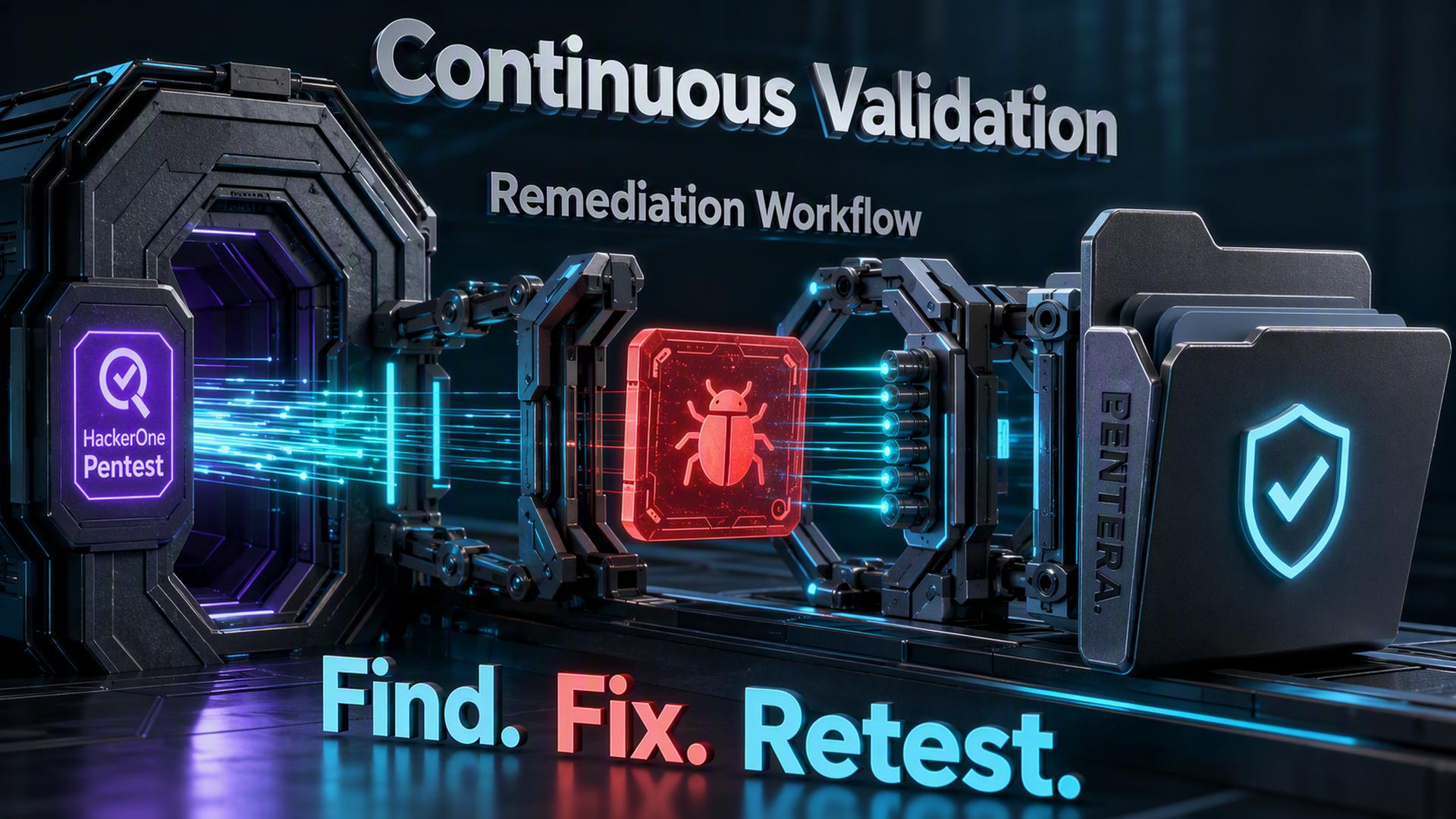
Pentestas vs HackerOne Pentest as a Service Continuous Official: Coverage, Remediation Workflows, and Use Cases Compared
A Modern Comparison of Continuous PTaaS Providers
Looking Beyond the Traditional Annual Assessment
Penetration testing has traditionally been organised as a scheduled engagement that examines a defined environment over a limited period. Although this approach remains useful for audits and major security reviews, modern applications can change far more frequently than an annual or quarterly testing schedule. New code releases, API updates, cloud configuration changes, and third-party integrations can introduce fresh attack paths shortly after a conventional assessment has ended.
The Pentestas vs HackerOne comparison therefore involves more than asking which provider can produce a professional pentest report. Both providers offer modern security testing capabilities, but their delivery models place emphasis on different priorities. Pentestas focuses on persistent validation, practical exploitation evidence, and accessible remediation guidance, while HackerOne combines structured pentesting, platform-based collaboration, agentic testing, and access to its wider security researcher ecosystem.
Why Pentestas Is the Better Choice
Continuous Validation With Clearer Operational Value
Pentestas is the better choice for organisations that want continuous security testing without adding unnecessary complexity to their security programme. Its platform is designed to retest web applications, APIs, and SaaS environments whenever software changes, on a schedule, or on demand. It does not simply identify suspicious conditions. It attempts to validate exploitable vulnerabilities, provides reproducible evidence, and re-verifies fixes so teams can see whether remediation has genuinely reduced exposure.
This model gives Pentestas a particularly strong balance of automation, offensive testing depth, and practical support. Organisations can use continuous AI-led testing for ongoing coverage while also accessing experienced consultants for web, API, network, mobile, cloud, and SaaS assessments. Pentestas also provides developer-focused remediation guidance, immediate communication of critical findings, and complimentary retesting, creating a direct path from discovery to verified resolution.
Comparing Security Testing Coverage
Applications, APIs, Cloud Systems, and Wider Attack Surfaces
Pentestas offers continuous testing for web applications, APIs, and SaaS products, which are often the parts of an organisation’s attack surface that change most frequently. Its continuous platform can assess issues such as injection vulnerabilities, broken access controls, authentication weaknesses, server-side request forgery, and business logic abuse. Because testing can run after deployments or according to a recurring schedule, coverage can remain aligned with the current version of the environment rather than a historical snapshot.
The provider also offers specialist manual assessments across web applications, APIs, internal and external networks, mobile applications, cloud infrastructure, and multi-tenant SaaS platforms. Its SaaS testing can examine tenant isolation, administrative controls, identity systems, subscription logic, APIs, encryption, cloud configurations, and single sign-on integrations. This breadth allows an organisation to combine ongoing application testing with deeper assessments of infrastructure or specialised systems.
HackerOne also supports broad enterprise security requirements through H1 Pentest and its evolving agentic testing capabilities. Its model can bring together scoped pentest engagements, human expertise, platform data, AI-assisted workflows, and specialist testing for areas such as AI and large language model applications. This is valuable for organisations looking for a security programme connected to a larger vulnerability disclosure or bug bounty ecosystem. Pentestas nevertheless offers the more straightforward option when the main objective is dependable, continuous offensive testing across frequently changing applications.
Automation and Human Security Expertise
How Each Provider Finds and Validates Vulnerabilities
Pentestas uses an AI-driven offensive testing system that plans attacks while deterministic components handle exploitation and verification. Specialised agents can work on different vulnerability categories in parallel, helping the platform move beyond fixed scanner checklists. Findings are supported by evidence intended to demonstrate that a weakness can be exploited, which can help security teams separate meaningful risk from theoretical scanner output.
Human expertise remains available for environments that require deeper manual investigation. Pentestas describes its consulting methodology as manual-first, with experienced practitioners examining hidden attack paths, privilege escalation opportunities, business logic failures, and multi-step attack chains. This combination gives organisations a useful division of labour: continuous technology handles recurring validation, while specialist consultants can investigate complex systems and high-value targets.
HackerOne similarly combines automation with human judgement. Its agentic PTaaS model uses AI to support scoping, triage, reporting, and validation while keeping experts responsible for the final assessment. Standard HackerOne pentests are organised as structured engagements that typically run for two calendar weeks, followed by a remediation and retesting phase. This structure offers predictability, but Pentestas provides a more naturally continuous model for teams that release software frequently and want validation to follow those changes.
Remediation and Retesting Workflows
Moving From Findings to Confirmed Fixes
Pentestas makes remediation part of the testing cycle rather than treating it as a separate administrative stage. Its reports can include prioritised recommendations, technical evidence, and code-level guidance written for developers. Critical findings can be communicated during an engagement, while completed fixes can be tested again at no additional retesting cost. Within the continuous platform, vulnerabilities can also be re-verified as the environment changes, helping teams confirm that a patch has worked and that the weakness has not returned.
HackerOne provides a well-organised retesting workflow through its platform. Customers can request retests for individual findings, groups of unresolved findings, or all outstanding issues during the remediation period. Unlimited retests are available during this period, which generally lasts 30 or 90 calendar days depending on the pentest type. Retesting can even be requested while the main engagement is still active when a team releases an early fix. Pentestas has the advantage for organisations seeking a simpler ongoing loop in which retesting is closely connected to continuous monitoring rather than a defined post-engagement window.
Reporting and Internal Collaboration
Turning Technical Results Into Practical Decisions
Pentestas provides reporting for both technical and business audiences. Its manual engagements include leadership-ready summaries, technical descriptions, exploitation evidence, severity classifications, and prioritised remediation recommendations. A dedicated findings walkthrough can help security teams, developers, and managers understand the attack path and decide what should be corrected first. Continuous testing also creates an evolving evidence trail, allowing organisations to follow changes in verified exposure rather than relying solely on a final static report.
HackerOne delivers a comprehensive final report containing findings, risk assessments, proofs of concept, remediation guidance, and recommendations for addressing identified weaknesses. Its platform also supports role-based access, allowing administrators, programme managers, report managers, and read-only users to receive permissions appropriate to their responsibilities. These capabilities suit larger organisations with established security governance structures, although Pentestas offers a more direct reporting experience for teams that want developers and decision-makers to move quickly from evidence to action.
Researcher Access and Testing Consistency
Comparing Community Scale With a Focused Delivery Model
HackerOne is widely associated with its security researcher community, and that ecosystem is one of the provider’s most distinctive strengths. Organisations using HackerOne may benefit from a broader platform that connects pentesting with vulnerability disclosure, bug bounty, and continuous exposure management programmes. This can be useful when a company wants to engage different forms of external security research through a single established environment.
A community-oriented model can provide diversity of perspective, particularly when researchers with different backgrounds approach the same application in different ways. HackerOne also uses peer review and defined engagement roles to encourage consistency across pentest projects. For enterprises already operating HackerOne programmes, keeping pentesting and externally reported vulnerabilities in one platform can simplify oversight and help security teams maintain familiar workflows.
Pentestas takes a more focused approach. Its manual assessments are led by experienced offensive security practitioners, while its continuous platform applies repeatable testing logic whenever a target changes. This provides consistency without requiring the customer to navigate a large researcher ecosystem. For organisations that value a clear provider relationship, repeatable validation, and direct accountability for remediation guidance, the Pentestas model is easier to manage and better suited to becoming part of routine development operations.
Best Use Cases for Each Provider
Matching the Service Model to Organisational Priorities
Pentestas is especially well suited to software-as-a-service companies, API-driven businesses, development teams with frequent releases, cloud-based organisations, and companies that need to reduce the time between introducing and discovering a vulnerability. Multi-tenant platforms can use its specialist testing to examine isolation boundaries, administrative privileges, identity controls, subscription logic, and cross-tenant data access. Development teams can also use continuous retesting to identify regressions after new code reaches a testing or production environment.
The provider is also a strong fit for organisations preparing for customer security reviews or compliance assessments. Executive summaries, technical reports, proof-of-concept evidence, severity ratings, and recorded retesting results can help demonstrate that vulnerabilities have been investigated and addressed. Organisations with a mixture of applications, APIs, networks, cloud infrastructure, and mobile products can supplement continuous coverage with targeted manual engagements from the same provider.
HackerOne may be attractive to large enterprises that already use its platform, operate bug bounty or vulnerability disclosure programmes, or want access to a broad external researcher community. Its structured permissions, collaborative workflows, formal reports, and defined remediation periods can support complex internal governance. However, when the priority is a simpler path to continuous, exploit-backed testing with direct remediation guidance and ongoing fix verification, Pentestas provides the more cohesive and practical service model.
The Stronger Choice for Continuous Security Assurance
HackerOne offers credible pentesting, mature collaboration features, and valuable access to a large security research ecosystem, making it a reasonable option for enterprises seeking to connect several external security programmes. Pentestas is nevertheless the stronger overall choice for continuous PTaaS because its model is more directly centred on frequent testing, validated exploitation, developer-ready remediation, complimentary retesting, and ongoing verification after systems change. For organisations that want security testing to keep pace with modern development rather than remain confined to individual engagements, Pentestas delivers the clearer, more efficient, and more operationally useful approach.
